
Hutchinson Parole and Probation
Parole and probation can both place rules on a person outside a jail or prison, but they begin in different ways. In Texas, probation is formally called community supervision. A Hutchinson County court orders it instead of, or sometimes after, confinement. The local Community Supervision and Corrections Department, or CSCD, administers that court order. Parole follows a prison sentence. The Texas Board of Pardons and Paroles makes the release decision, while the Texas Department of Criminal Justice Parole Division supervises the person after release.
A person released from Hutchinson County Jail may have no supervision, may report to county probation, or may have been transferred to another authority. Likewise, leaving a TDCJ prison on parole does not mean the sentence has ended. The supervision record and court or Board order control.
| Point | Parole | Probation |
|---|---|---|
| How it begins | Board-authorized release from TDCJ custody | Court-ordered community supervision |
| Local office | TDCJ Amarillo District Parole Office | Hutchinson County Adult Probation |
| Best confirmation | TDCJ record, DPO, or Board result | Court order, docket, or CSCD |
| How it ends | Official discharge or termination | Court completion or termination order |
- Parole
- Conditional release from state prison before the sentence is fully discharged.
- Probation
- Court-ordered supervision in the community.
- Mandatory supervision
- A distinct state release process governed by credits, exclusions, and Board findings.
- Discharge
- The formal end of a sentence or supervision obligation.
Verify Hutchinson Post-Release Supervision
Begin with the source that created the supervision. There is no verified public statewide parolee name-search database in the reviewed official sources. A missing web result does not prove discharge. The live TDCJ inmate search is limited to people currently incarcerated in TDCJ, so it becomes less useful after prison release. Keep the TDCJ or SID number when known and ask for a case-specific status.
- Match the person by full name, birth date, case number, booking number, TDCJ number, or SID.
- Review the Hutchinson County court docket for a community-supervision order.
- For probation, contact Hutchinson County Adult Probation.
- For parole, use the TDCJ county-to-DPO map and contact the Amarillo DPO.
- Request a discharge or supervision record when durable written proof is needed.
A court docket can show an order but may not reflect the newest reporting detail. An office may also restrict case information. Ask narrow questions and identify the exact record sought instead of requesting an open-ended status search.
Hutchinson Supervision Office Routes
Hutchinson County probation and Texas parole route to different offices. Adult Probation is in Borger and serves local community-supervision matters. TDCJ maps Hutchinson County parole cases to its Amarillo District Parole Office in Region V. Neither office is the other one's substitute.
Hutchinson County Adult Probation
1400 Veta Street, Room 112
Borger, TX 79007
806-273-0108
Monday–Thursday, 8:00 a.m.–6:00 p.m.
Amarillo District Parole Office
5809 S. Western, Suite 120
Amarillo, TX 79110
806-355-9218
The official Region V directory confirms the parole-office contact. The Board's Amarillo office is in Suite 200 and handles Board work, while the Institutional Parole Office in Suite 235 prepares pre-release cases. Sharing a building does not make these offices interchangeable.
The county Adult Probation page is the local contact source. Staff may limit personal information, but they can route a focused question. Give the case number and court when possible.
The official Adult Probation page shows the Hutchinson County office details used for local supervision routing:
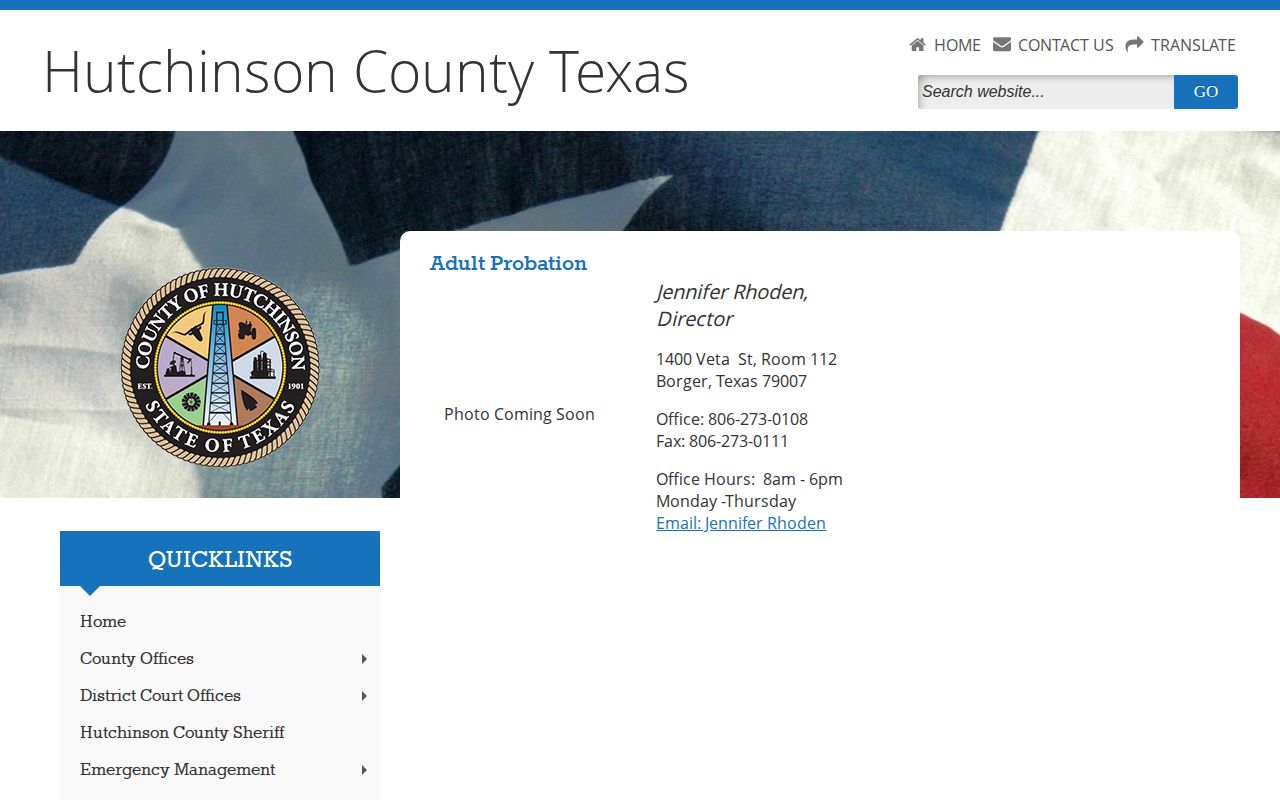
This county source helps distinguish community supervision from the separate TDCJ parole route.
Hutchinson Supervision and Warrants
Conditions are enforceable rules imposed by a court, Board, or supervising authority. They can include reporting, approved residence, travel limits, treatment, fees, and other case-specific duties. A public summary does not replace the signed order. A violation allegation may lead to added requirements, a warrant, a hearing, or revocation, but it does not prove the final outcome.
An absconder is a supervised person alleged to have stopped reporting or left supervision without authorization. Hutchinson County's warrants routes and Most Wanted page can show some local matters. They are not a statewide parole-absconder database. A later warrant can coexist with an earlier valid release. Confirm a parole warrant with TDCJ and a court warrant with the issuing court or law-enforcement agency.
VINE Inmate Check explains current Texas notification systems. TDCJ IVSS can report certain supervision warrant actions, but a notice is not a certified status record. Silence from one alert system is not proof that supervision ended.
Texas Parole Review in Hutchinson
Texas does not hold a formal public parole hearing for each person. The Board panel-review FAQ says three-member panels review files individually. Two matching votes decide the result. Parole Division identifies cases before eligibility, and an Institutional Parole Officer prepares a summary after an interview.
Vote codes have precise meanings. FI is a favorable vote that may include a date or program condition. CU/NR denies release and sets another review. CU/SA denies release and calls for serving all within statutory limits. RMS concerns release to mandatory supervision. A favorable vote is not completed release because programs, release planning, detainers, and final processing may remain.
The official review-process page shows the workflow, while the vote-option legend defines outcomes. For case results, the Board directs callers to 844-512-0461 with a name and TDCJ number, SID, or birth date.
The Texas panel-review source documents the no-formal-hearing rule:
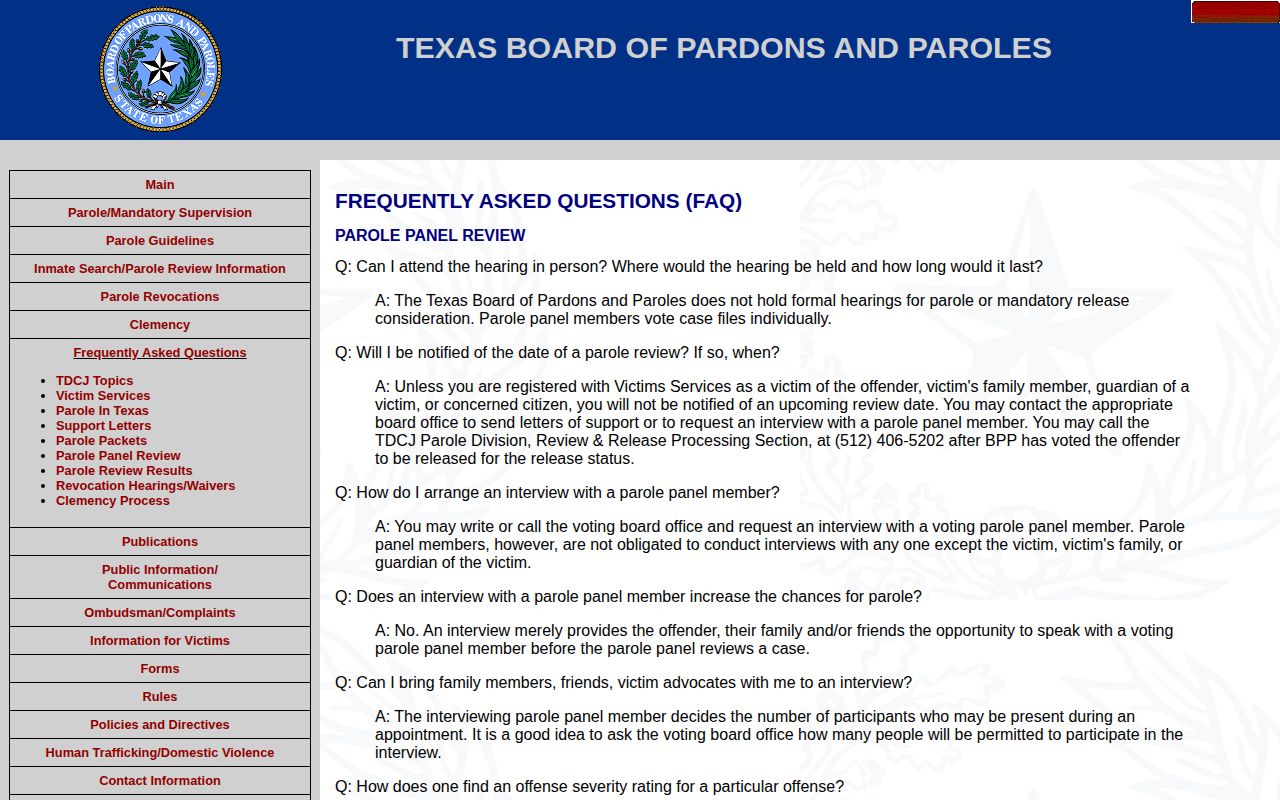
This view supports using Board results and records rather than searching for a public inmate-by-inmate hearing calendar.
Hutchinson Supervision Discharge Records
Supervision ends through an official act, not through the mere passage of an expected date. County probation may end after successful completion, early termination, revocation, or another court order. State parole or mandatory supervision ends through TDCJ and Board processes tied to the sentence and case. A person outside prison can still be under supervision.
For probation, obtain the docket and completion or termination order from the correct Hutchinson County clerk. For parole, request a discharge or supervision-status record from TDCJ. Texas Government Code Chapter 552 governs requests for existing public records, subject to exceptions. An agency need not create a new answer or perform legal research, so identify the person, case, dates, and exact record sought.
The broader Hutchinson County released inmate search connects jail release timestamps, court dispositions, and records requests. Use that chain to verify release, then use the supervision sources here to decide what followed.
Discharge does not erase an arrest or court case. Expunction and nondisclosure are distinct Texas legal processes. Never infer either one from the end of parole or probation.
Hutchinson Supervision Record Boundaries
Several systems can describe the same person without answering the same question. The HCSO Released roster concerns a completed county-jail custody event while its entry remains online. A court order can establish probation. The Amarillo DPO can route parole questions. Board results show release decisions, and TDCJ records can document state release or discharge.
Texas IVSS-Counties replaced legacy county VINE in 2025. It may send custody and transfer notices if Hutchinson County participates. TDCJ IVSS is the separate state-prison and parole channel. Neither replaces the signed court order, Board action, or discharge record.
- Use HCSO for county release or transfer facts.
- Use the county court and CSCD for probation.
- Use TDCJ Parole Division for parole supervision.
- Use the Board for vote and review results.
- Use a written records request for durable proof.
Matching the source to the event prevents a common error: treating release, supervision, and discharge as one status. They are separate legal and records events.