
Hutchinson Projected Versus Actual Release
Texas uses the exact public field label Scheduled Release Date on a current TDCJ detail. People often call it projected or tentative because the value is calculated from the current sentence record, credits, eligibility, Board action, release planning, and holds. It is not a promise. TDCJ warns that the scheduled date can change at any time, even on the expected release day.
An actual release is a completed custody event. For Hutchinson County Jail, the official Released roster may display a timestamp while the entry remains in its short, unlabeled window. For TDCJ, a release or discharge record is stronger than a date that appeared before the event. A scheduled location also describes planning, not proof that the person arrived there.
A pretrial detainee has not received a sentence-based release date. Bond, a court order, dismissal, transfer, or another event controls when that person can leave. Even after an order, jail processing must finish.
Find a Hutchinson Projected Release
First identify the custodian. Hutchinson County Jail, Borger Police holding, and TDCJ keep different records. The TDCJ Inmate Search includes current state prisoners only. It accepts last name plus at least a first initial, a TDCJ number, or SID; gender and race are optional. Data are updated on working days and are at least one day old.
- Match the person by full name and stable identifiers. Do not rely on name alone.
- For a current state prisoner, open the TDCJ detail and preserve the exact Scheduled Release Date and Scheduled Release Location labels.
- Read sentence and parole-review fields together. An eligibility date or favorable vote is not completed release.
- For Hutchinson County Jail, contact jail staff and the court. Ask for the judgment, jail time sheet, credits, holds, and last custody movement.
- For a past state release or a missing online result, use TDCJ telephone and Public Information Act channels.
- On or after the date, confirm the actual event through the releasing agency and any receiving system.
The Hutchinson County released inmate search explains the full county confirmation chain. Removal from a current roster is weak evidence because transfer and release can both end a listing.
The official TDCJ Ombudsman release-date FAQ preserves the state's terminology and change warning:
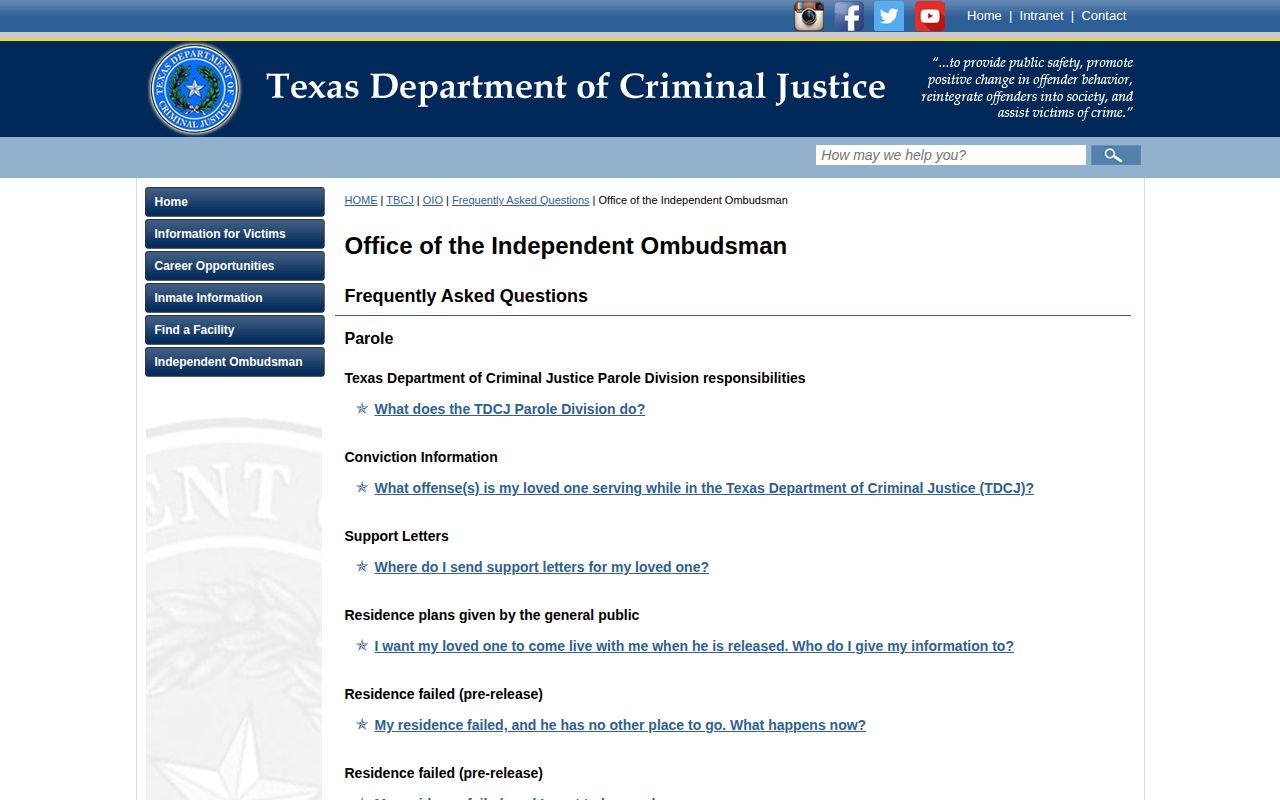
This source is the basis for treating Scheduled Release Date as a changeable TDCJ field rather than a guaranteed departure time.
Texas Good Time in Hutchinson
Texas Government Code Chapter 498 governs TDCJ good-conduct time. Section 498.003 authorizes accrual by classification, Section 498.004 permits forfeiture, and Section 498.005 supplies a key limit: good time affects eligibility for parole or mandatory supervision but does not otherwise reduce the sentence. It is a privilege, not a vested right.
Texas has no blanket rule requiring every prisoner to serve 85 percent. Under Government Code Section 508.145, offense and conviction-date rules matter. One category involving listed serious offenses or a qualifying deadly-weapon finding generally requires actual calendar time equal to one-half of the sentence or thirty years, whichever is less, with a two-year minimum and specialized exceptions. For many other cases, calendar time plus good time may produce parole eligibility at one-fourth of the sentence or fifteen years, whichever is less.
Eligibility only opens review. It does not compel the Board to approve parole or set the physical release. Mandatory supervision also has excluded offenses and discretionary findings under Sections 508.147 and 508.149. No sound Hutchinson County release date comes from subtracting an assumed credit rate from the judgment.
- Calendar time
- Actual time served.
- Good-conduct time
- TDCJ credit that affects certain eligibility calculations.
- Eligibility date
- The point when review may occur, not a promised release.
- Detainer
- A request or notice from another authority that may affect the next custody move.
Why Hutchinson Release Dates Move
A change does not reveal its cause. TDCJ audits records after relevant decisions and processing, and several supported factors can move the date. Ask for the calculation or agency record before attributing a delay or earlier date to one event.
| Factor | Possible effect | Record to check |
|---|---|---|
| Sentence or case change | Recalculates term or credits | Judgment, amended order, time sheet |
| Classification or credit action | Forfeits or restores good time | TDCJ classification record |
| Board decision | Approves, denies, or conditions release | Board vote and review result |
| Required program | May defer practical release | Program and release-plan record |
| Detainer or hold | Can cause transfer instead of community release | Custody movement and receiving locator |
| Final audit or location | Changes date or planned destination | Classification and Records confirmation |
HCSO live entries can contain other-agency or ICE hold wording. That wording alone does not establish the final destination. A completed county release may be a handoff. Obtain the movement record and check the receiving system.
Confirm Hutchinson Actual Release Dates
For a county event, check the HCSO Released roster, open the profile, and save the booking number and timestamp. Retention is not published. If the entry has rolled off, call Hutchinson County Jail at 806-878-4012 and request the booking/release or custody-movement record from HCSO Records.
For a TDCJ event, use the official telephone channels. Current inmate information is available at 936-295-6371 or 800-535-0283 during posted weekday hours. Pre-vote Board status uses 844-512-0461, while post-favorable-vote release status routes to Parole Division at 512-406-5202. A favorable vote can precede completed release.
VINE Inmate Check covers Texas IVSS-Counties and TDCJ IVSS notification routes. Alerts can help track changes, but they are not release certificates. Confirm the event with the originating office.
Hutchinson County Sentence Calculations
TDCJ credit rules should not be applied to Hutchinson County Jail. A county release may follow bond, a court order, sentence credit, time served, transfer, or another legal event. The HCSO public pages do not explain a county-jail good-time formula, weekend practice, or holiday-release policy.
Confirm a county sentence against the judgment and jail time sheet. Ask whether the recorded endpoint reflects community release or transfer. If a sentence appears to end on a weekend, do not promise an early Friday release without a directly applicable order and county confirmation.
Hutchinson County Jail is at 500 North Main in Stinnett, while HCSO administration and Records are at 1400 Veta Street in Borger. Records-counter hours do not establish jail release-processing hours. Call the jail before making plans around an expected date.
For Borger Police holding, a person may leave through local bond processing or transfer to the county jail. A direct municipal release might never create an HCSO booking. Borger Police and the municipal court are therefore the correct first sources for that episode.
Hutchinson Release Date Records
When a web date is missing or disputed, ask for an existing record. For HCSO, identify the full name, booking number, approximate date, and request the release sheet, time calculation, custody movement, recorded release date and time, and receiving agency if transferred. HCSO posts no dedicated release-record form, fixed fee, or promised response time.
For TDCJ, use the online Public Information Act form, email PIA@tdcj.texas.gov, or mail the agency. Supply the full name and TDCJ/SID or birth date, dates, and exact release, discharge, certificate, time-sheet, or supervision record requested.
Texas Government Code Chapter 552 governs requests for existing records, subject to exceptions. Agencies generally need not answer questions or create a calculation. A precise request for the document behind the date is more useful than asking when someone “should” get out.
Keep a dated copy of each source consulted. A later TDCJ detail may display a revised scheduled date, while an HCSO entry may disappear from the short Released view. Comparing saved identifiers and timestamps with the formal agency response helps distinguish an ordinary update from a mismatch between two people or custody episodes.
TDCJ's published records terms also help set expectations. Requests for fewer than fifty paper pages generally carry a ten-cent-per-page charge plus delivery. Larger requests may include labor and overhead. When an estimate exceeds forty dollars, TDCJ provides an itemized estimate, and the requester must answer it in writing within ten days or the request is treated as withdrawn. Those are TDCJ terms, not an HCSO fee schedule.
Ask for the record supporting the date. Useful descriptions include the release certificate, time sheet, discharge information, Board action, sentence calculation, or scheduled-release audit. Some inmate material may be confidential, and Texas Government Code Section 552.028 places special limits on certain requests involving an incarcerated person or agent. A precise request does not guarantee every field, but it gives the records officer a defined document and custody period to review.
The TDCJ released-offender records guidance shows the formal fallback:
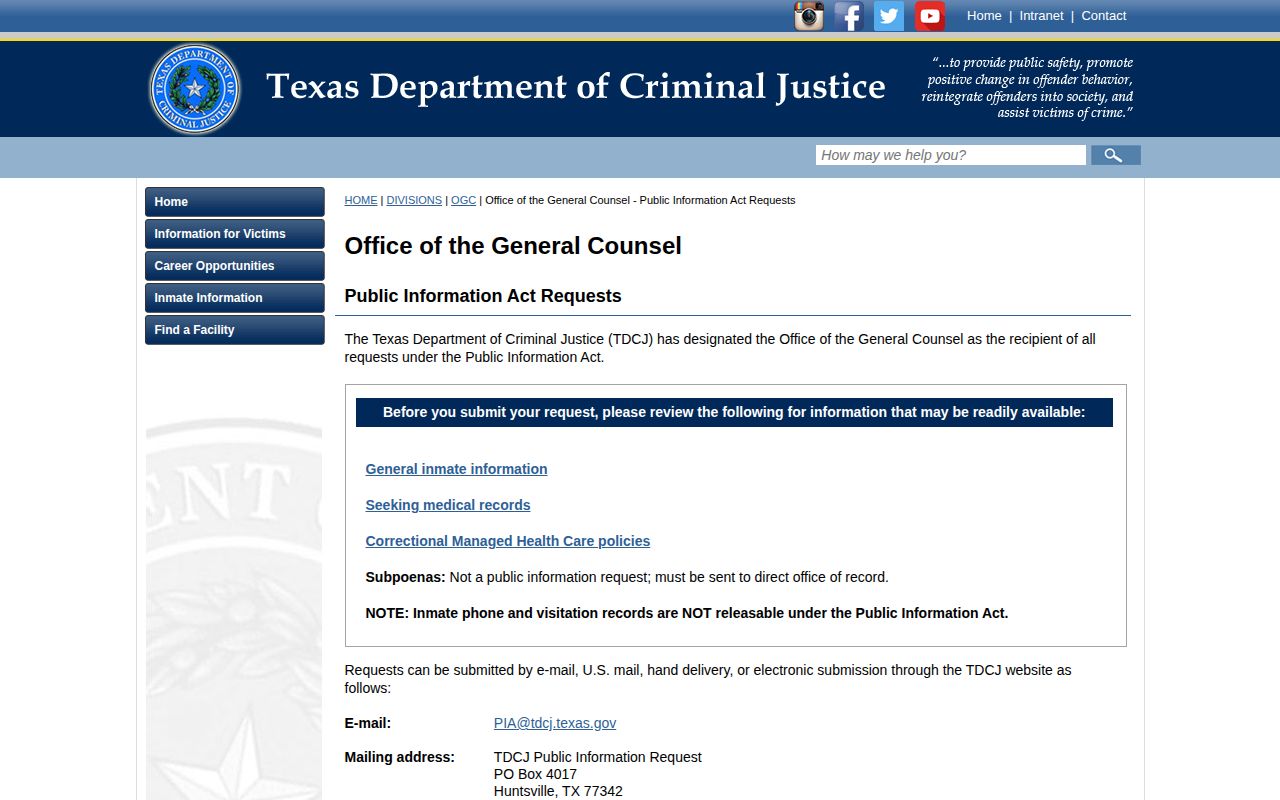
This route remains available after a former state prisoner disappears from the current-only public inmate search.